In my family, food was love—as long as I stayed small
Not petite enough to fit in with her family. Not white enough to fit into pop culture. Weight Watchers’ head of food content Sherry Rujikarn reflects on finding strength in individuality, and refusing to shrink herself for anyone.
I can’t pinpoint the exact age the comments started. Was I nine years old? Eight? I might’ve been seven. The throwaway remarks about my larger body during family gatherings. The accusations from my Aunt Lek that I ate too much. It hurt me, but it also confused me — because growing up in a Thai and Chinese house, food was everything.
Even as a small child, I’d choose the Food Network over the Cartoon Network any day. Standing behind the kitchen counter, I’d narrate putting together the perfect turkey sandwich, pretending I was Bobby Flay or Sara Moulton. (Is it any wonder I made cooking my career?) A true “foodie” before that term became overused, my mom made sure we took advantage of the fact that we lived in New York City — one of the most exciting places in the world to eat — by taking us to all the international markets and all kinds of restaurants.
She was an amazing cook in her own right, who had mastered both western dishes and the Thai cuisine of her homeland. While every day was reason enough to cook something exquisite, for her, Thanksgiving was the real time to shine — her Super Bowl, her Olympics. She loved the tradition and everything she cooked was as classic as she understood it: sweet potatoes with mini marshmallows, chestnut stuffing, mashed potatoes, cranberry sauce, turkey, the American works.
It took three days of cooking and prep. Then, on Thanksgiving morning, I’d wake up to the sounds of pots clanging and the scent of sizzling garlic. I’d scramble to the kitchen, still in my pajamas, eager to help. I loved everything about it: the fridge overflowing with carrots and butter, time off from school, the Macy’s Thanksgiving Day parade in the background, the pies. My extended family would gather at our apartment. Aunts, uncles, cousins, and family friends would trickle in, a steady chorus of intercom jangles and doorbell rings.
The smells and the sounds once stirred pure excitement in me, but as I got older — and my body became a topic mentioned with the same ease as the weather — I came to dread the day, and would spend parts of it crying in my closet. In our culture, feeding was a love language, but my wires became crossed when the food came with a side of body shaming. And God forbid I didn’t finish what was in front of me. That type of waste would never fly.
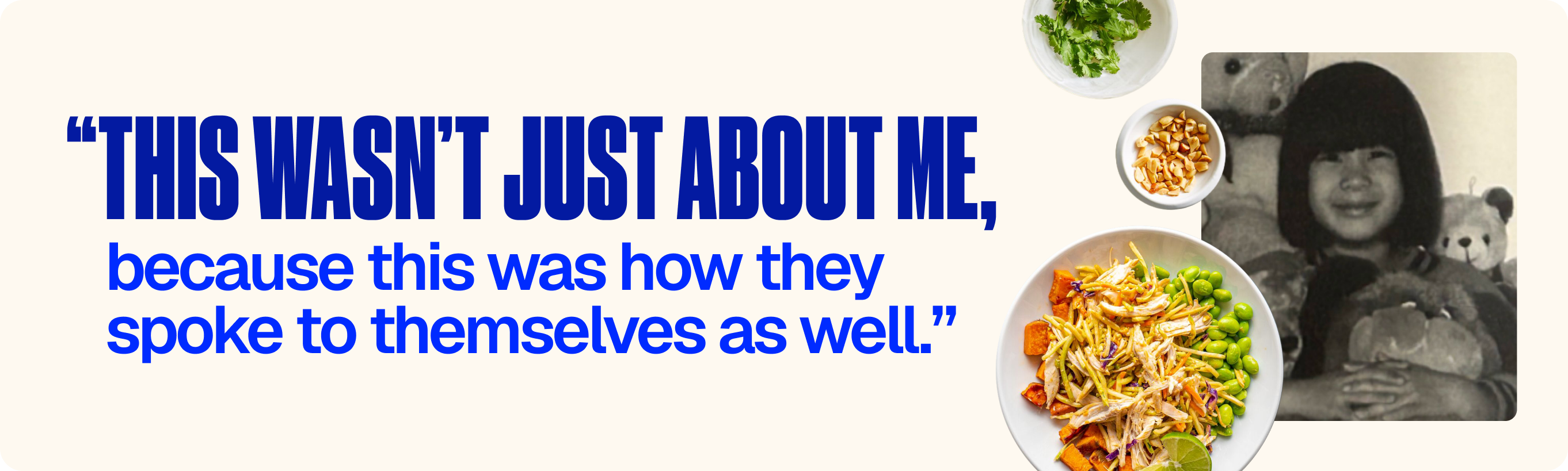
No one ever spoke to me the way my family members did — not my third-grade teacher, not my babysitters, not my friends. I’m always naively shocked at how your own family can make you feel the worst about your body. It took a long time for me to recognize that this was cultural. It wasn’t just about me, because this was how they spoke to themselves as well.
This criticism made me acutely aware, at a too-young age, that I didn’t fit the Asian ideal. I wasn’t petite or fine-boned. I didn’t have narrow hips and never would. The word “skinny”? Didn't know her. While my sister and I were both on the tall side for Asian girls — acceptable, sometimes venerated — she was long and willowy. I was sturdy and strong, a varsity athlete with muscular legs.
But I didn’t fit the American ideal either. I entered my tweens in the era of “heroin chic,” and my teen years saw pop idols — all white, most blonde — ripped apart for typical adolescent weight fluctuations. No matter where I turned, there weren’t any broad-shouldered Thai-Chinese American females of taller-than-average height anywhere I looked. Not even in my own family.
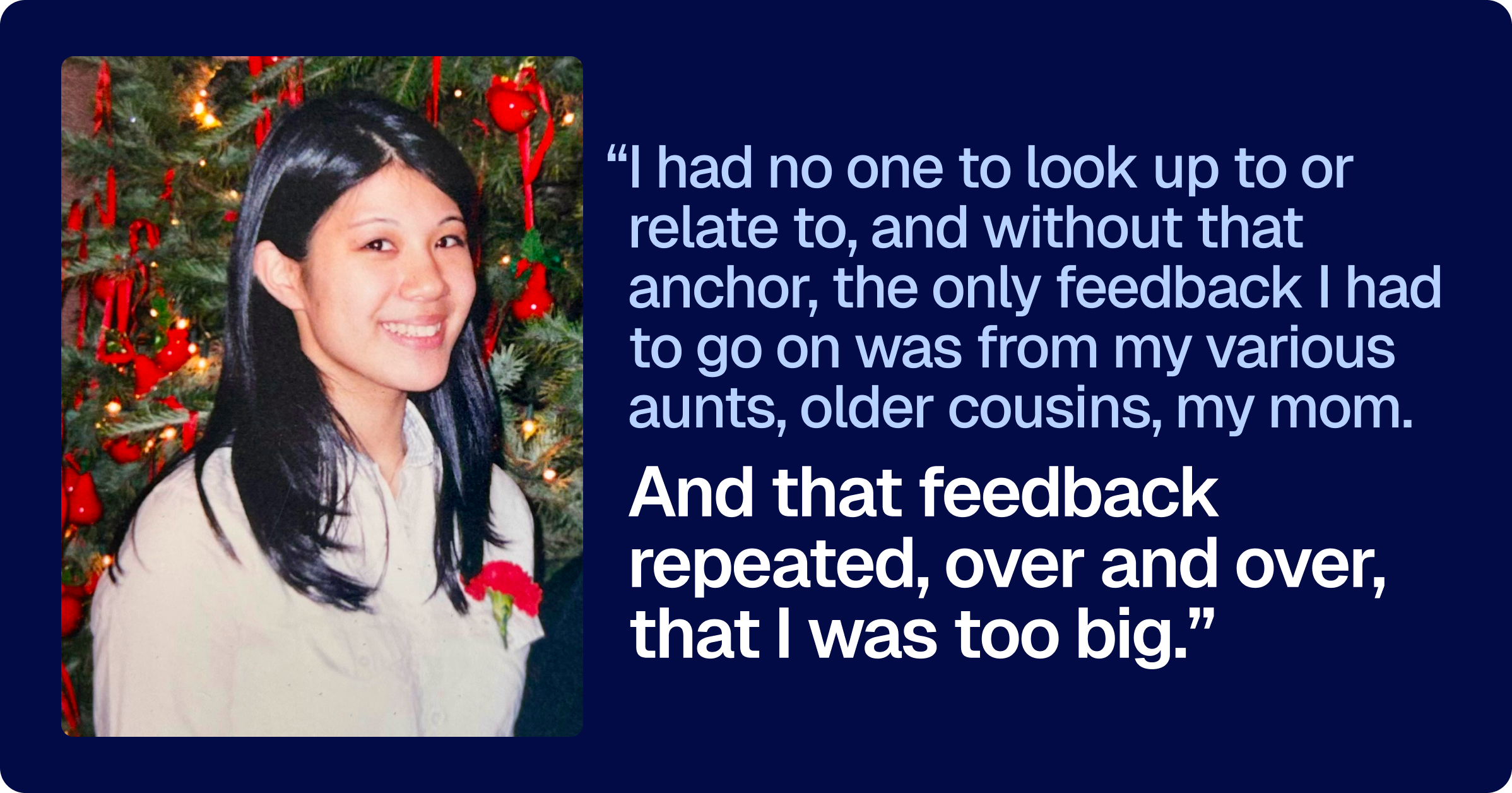
As a minority in the US, I was used to being different, but I considered myself lucky to feel accepted at my school, among my friends, and in my diverse hometown. But feeling accepted and feeling seen are two different things. Acceptance is a baseline — the lowest bar, just above tolerance. Not having any kind of mirror was disorienting. I had no one to look up to or relate to, and without that anchor, the only feedback I had to go on was from my various aunts, older cousins, my mom. And that feedback repeated, over and over, that I was too big. It colored the way I saw myself well into adulthood — whether a size 6 at my smallest or a size 14 postpartum.
It took decades to learn how to separate the noise from the facts, and to listen to myself instead of everyone else — which is how I came to understand what being healthy actually looks and feels like for me. It took strength to find body confidence, untethered from external opinions, and to stop automatically reaching for whichever clothes made me look the smallest.
It took gaining perspective from my accomplishments, friendships, grief, love, and motherhood. These experiences expanded my sense of self, transforming it from something merely physical into a rich and textured portrait of who I am, inside and out. It took growing — not shrinking — to realize that I don’t have to look like the typical Asian-American woman, and I don’t care that I’ll never be described as petite.
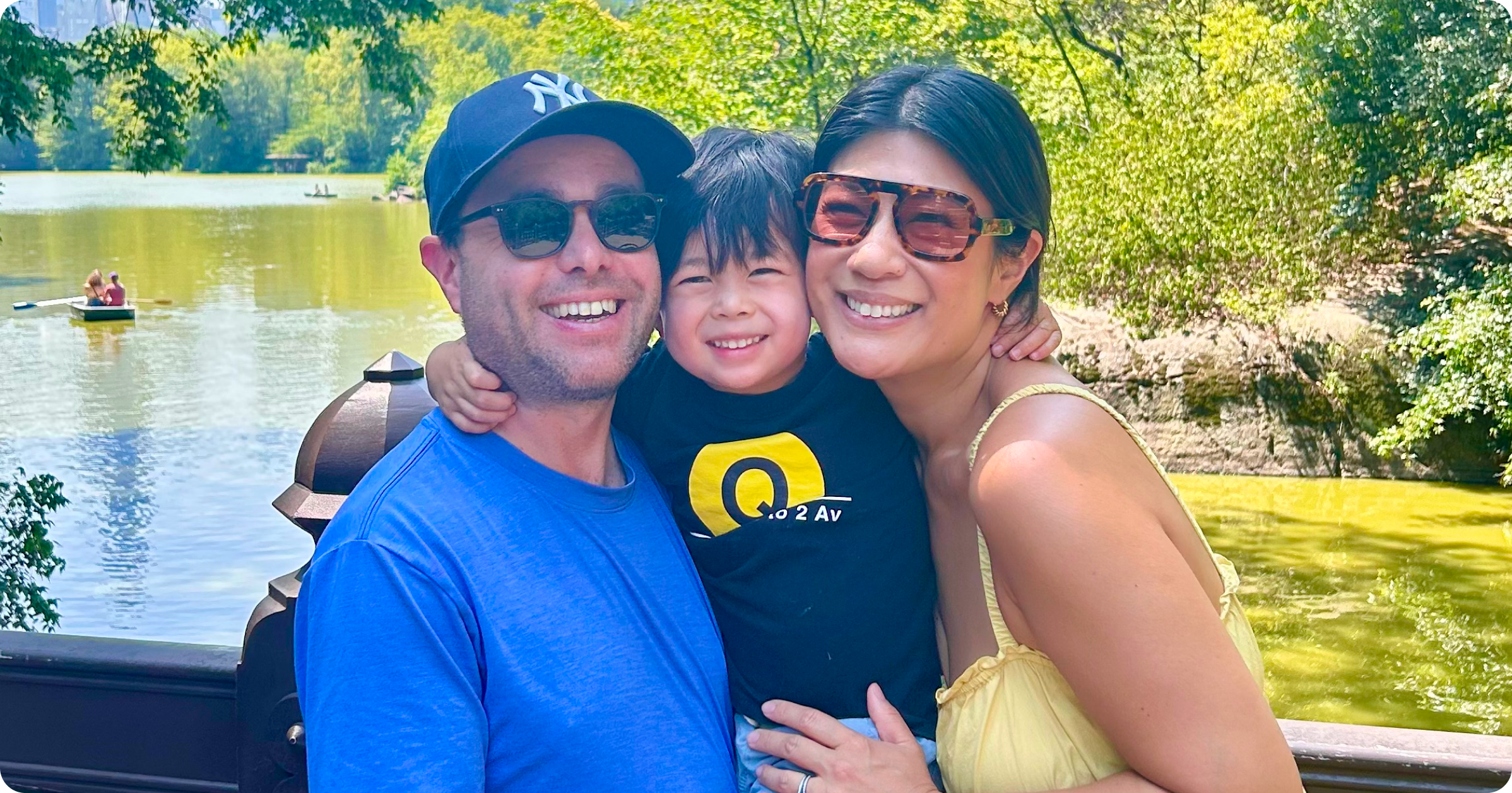
Now, I’m the one hosting Thanksgiving dinner. I have my own child who “helps” me in the kitchen. Between dusting the flour out of his hair and cleaning the dribble of raw egg he leaves on the counter, I make sure he knows that it’s his health and strength that matter most to me when it comes to his body. He can eat as many helpings of my chestnut stuffing as he wants, and he can stop when he is full. If he does cry that day, it won’t be because anyone has made him feel self-conscious about his weight — but because he doesn’t want to go to bed, knowing that the house is still full of people who love him, even though they look nothing like him.